
Liquefied Petroleum Gas (LPG)
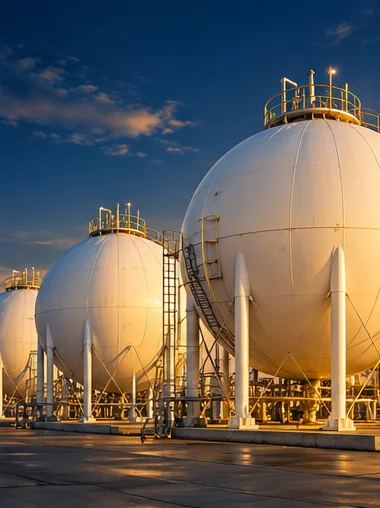
Liquefied petroleum gas (LPG) is a portable, high-energy fuel made mainly of propane and butane. It burns cleanly, stores as a liquid under moderate pressure and needs no dedicated pipeline, which is why distributors, bottling plants, industrial users and utilities rely on it for cooking, heating, cutting and process heat in regions where natural gas is not available.
INTBES supplies LPG in commercial propane and propane-butane mixtures, in full-pressure and refrigerated cargoes, with documentation that lets the buyer confirm composition, density and vapour pressure before the shipment is fixed.
Grades and composition
Two commercial families cover most of the market. The exact split is agreed in the sales contract and stated on the certificate of quality:
- Commercial propane — propane-dominant, suitable for high-consumption burners and cold-climate use where vapour pressure must stay reliable.
- Commercial butane and propane-butane mix — butane-rich blends for warmer climates, bottling and blending operations.
- Composition, density, vapour pressure, sulfur and moisture — reported on the certificate of quality for each cargo.
- Delivery options — full-pressure or refrigerated cargo, ISO tank, cylinder filling by arrangement.
- Minimum order quantity — set per route and per discharge terminal.
Where LPG is used
Demand comes from three directions. Household and commercial distributors fill cylinders for cooking and heating. Industry uses LPG for cutting, welding, heat treatment, kilns and standby generators where a clean, instantly available flame is required. Utilities and power producers use it as a peak-shaving fuel or as a transition fuel while a gas grid is built. Each of these buyers cares about a different figure — vapour pressure, sulfur, or calorific value — so the specification is matched to the end use rather than sold as a single generic grade.
Logistics and delivery
LPG moves as a liquid under pressure, so the logistics chain is chosen to match the discharge facility. Full-pressure vessels serve terminals with pressurised storage; refrigerated carriers serve large import terminals with cryogenic tanks. Loading port, laycan, Incoterm (FOB, CFR, CIF, DAP) and inspection are fixed in the offer. Cargo documents travel with the shipment so the receiver can verify quantity and quality on arrival.
Quality, safety and compliance
Every cargo is supported by a certificate of quality issued by an independent inspection company, and by the safety data sheet required for transport and storage. Composition is checked against the agreed specification before loading, not after arrival. Buyers receive the assay, the safety data and the shipping documents together, which keeps the customs and terminal formalities straightforward.
Frequently asked questions
What is the difference between commercial propane and a propane-butane mix? Commercial propane is propane-dominant and keeps a stable vapour pressure in cold weather. A mix carries more butane and suits warmer markets and bottling operations. The choice depends on climate and burner type.
Can LPG be supplied in small volumes? Bulk cargoes are the standard route. Cylinder and ISO-tank supply is arranged case by case depending on the destination and the distributor’s filling capacity.
Which documents come with the cargo? Certificate of quality, certificate of quantity, bill of lading, safety data sheet and the commercial invoice. Additional certificates are added when the destination requires them.
How is quality confirmed before loading? An independent inspector samples the cargo against the agreed specification. The certificate is issued before the vessel sails, so the buyer’s technical team can review it while the shipment is still under control.
Request an offer
Send the destination port, the required volume and the end use, and the trading desk will return a specification, an indicative price and a loading window. For related products, see light crude oil and base oils SN150 and SN500.